ECFMG Farsi Translation Requirements: A Complete Guide for Iranian Medical Graduates


ECFMG Farsi Translation Requirements: A Complete Guide for Iranian Medical Graduates
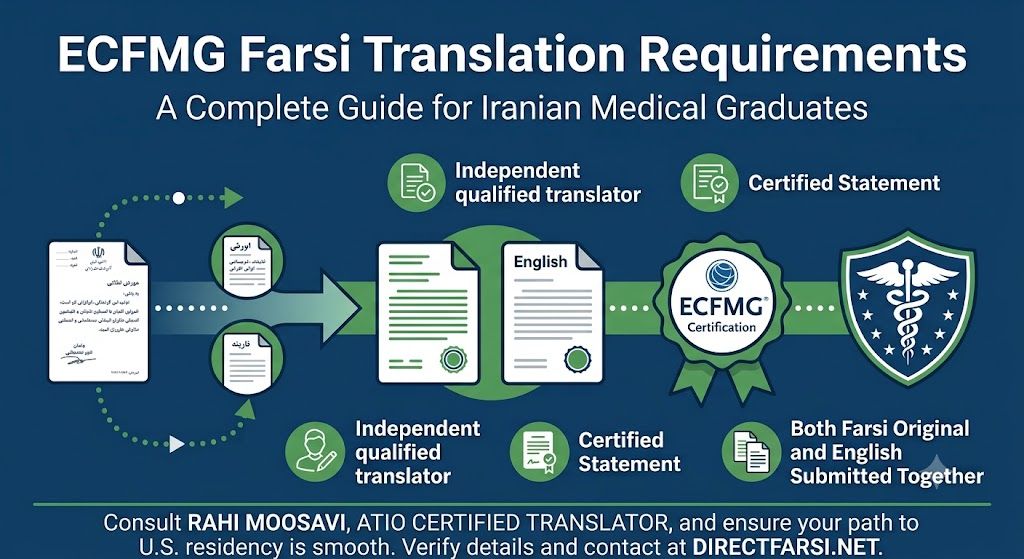
If you trained as a physician in Iran and you're pursuing ECFMG certification to practice medicine in the United States, one of the first hurdles you'll hit has nothing to do with medicine at all: getting your Farsi-language documents translated in a way ECFMG will actually accept.
This guide walks through what ECFMG requires, which documents typically need translating, and where Farsi-to-English translation gets genuinely tricky—so you know what to expect before you submit anything.
Hello, I’m Rahi Moosavi
Before we dive into the technical details, let me introduce myself. I am Rahi Moosavi, an ATIO Certified Translator and founder of DirectFarsi. Over the years, I have helped numerous Iranian medical graduates navigate the strict document verification process required for licensing and residency in North America.
Because ECFMG standards are incredibly precise, a single minor error in date conversion or layout can delay your application by months. I specialize in providing certified Farsi-to-English translations that strictly align with ECFMG's rigid criteria. If you are preparing your application, you can reach me directly at [email protected], call +1 416 875 2830, or visit my website at directfarsi.net to get your documents translated correctly the first time.
What Is ECFMG, and Why Does Translation Matter So Much?
The Educational Commission for Foreign Medical Graduates (ECFMG) verifies that international medical graduates (IMGs) meet U.S. training and credentialing standards before they can enter a U.S. residency program or sit certain licensing exams. Part of that verification is documentary: your diploma, transcripts, and other academic records have to be reviewed and confirmed by ECFMG and, ultimately, by your medical school directly.
If those documents were issued in Farsi—as essentially all Iranian medical school records are—they can't be submitted on their own. ECFMG requires the original-language document and an English translation that meets its specific translation standards. Get the translation wrong, and it's not just inconvenient—it can stall your entire certification timeline while your school re-issues records or you track down a new translator.
Which Documents Typically Need Translating
For most Iranian IMGs, the documents that require certified Farsi-to-English translation include:
Final medical diploma – your primary degree-completion document.
Academic transcripts – including transcripts documenting any transferred credits.
Course classification certificates – documents distinguishing general education courses (language, humanities, ideological studies) from specialized medical coursework. This distinction comes up often in Iranian transcripts and sometimes needs its own explanatory certificate.
Certificates of good standing or licensure, if applicable.
Letters from authorized medical school officials – in cases where a diploma hasn't yet been formally issued.
What ECFMG Actually Requires From a Translation
ECFMG's rules are specific, and they're stricter than what a lot of applicants expect. A compliant translation must meet the following criteria:
Be word-for-word: Summaries, abstracts, or "gist" translations are explicitly not accepted. Every sentence in the original has to appear, translated, in the English version—nothing condensed, nothing paraphrased into shorter form.
Come from the original document or a clean photocopy: Translations prepared from a transcription of the document (i.e., someone re-typing the Farsi text first) aren't accepted. The translator has to work from the actual document.
Include a signed certification statement: The translator—or an authorized official—must sign a statement attesting that the translation is complete and accurate. A translation without this statement, or one where the statement isn't properly signed, will be rejected outright.
Be done by a qualified third party: ECFMG does not allow applicants to translate their own documents, and it won't accept translations from friends or family members either. It has to come from a government official, a medical school official, or a professional translation service.
Be submitted alongside the original: Submitting only the English version, without the Farsi original attached, isn't accepted—and vice versa.
Why Farsi-to-English Translation Has Its Own Quirks
Farsi documents present a few structural challenges that don't come up with other languages, and a translator unfamiliar with Iranian academic documents can easily trip over them:
1. The Solar Hijri Calendar
Iranian documents date everything using the Solar Hijri (Shamsi) calendar, not the Gregorian one—so a graduation date might read "1397/08/26". These need to be carefully converted. Because the Persian new year falls in spring rather than January, sloppy conversions are an easy way to introduce an error that raises questions during credential verification.
2. Non-Medical Course Classifications
Iranian medical transcripts often include general-education requirements—Islamic Thought, the Islamic Revolution and its roots, Persian language and literature—that are mandated nationally but aren't part of the core medical curriculum. Iranian universities sometimes issue a separate certificate clarifying this distinction, and that certificate needs translating with the same word-for-word precision.
3. Seals, Stamps, and Signatures
Iranian academic certificates are typically authenticated with an official university seal and a handwritten signature from a university official, sometimes alongside a secondary registrar's stamp. A compliant translation needs to note these elements explicitly—such as [Official Seal of the University] or [Signature]—rather than silently omitting them. ECFMG's reviewers check that the translation reflects everything on the page.
4. Layout Mirroring
Because ECFMG's review process involves comparing the translation against the original document, translators should keep the same structural layout—reference numbers and dates where they appear in the original, the same paragraph order, and the same signature block placement—rather than reorganizing the content into a cleaner-looking but unfamiliar template.
Common Questions
Can I translate my own transcript if I'm fluent in both languages? No. Regardless of your own language skills, ECFMG requires an independent, qualified translator or certifying official—self-translations are not accepted under any circumstances.
What if part of the original document is hard to read? A qualified translator should flag illegible sections explicitly (e.g., [illegible in original]) rather than guessing at content. If a translator can't confirm a phrase or figure with confidence, it shouldn't appear in the translation as though it were certain.
Does the translation expire? Generally, a translation remains valid as long as the underlying document is current and ECFMG's own requirements haven't changed. Because certification requirements are periodically updated, it's worth checking ECFMG's current policies before assuming an older translation is still acceptable.
The Bottom Line & Next Steps
ECFMG's translation requirements are exacting by design. The certification process exists to verify that IMGs meet U.S. training standards, and a document mismatch or an uncertified translation is one of the most common—and avoidable—ways to slow that process down.
For Farsi-language documents specifically, working with an ATIO certified translator who understands the Solar Hijri calendar, Iranian academic structures, and ECFMG's word-for-word standard is what keeps your file moving instead of sitting in a review queue.
If you have questions about your documents or are ready to begin your translation, let's make sure your paperwork is flawless.
Email: [email protected]
Phone: +1 416 875 2830
Website: directfarsi.net
Disclaimer: This article is intended as general guidance and reflects publicly available ECFMG requirements as of 2026. Requirements can change—always verify current rules directly at ecfmg.org before submitting your documents.